
Informational Guide Types of Men’s Hair Systems: Lace, Skin, Mono, Net & Swiss Base Explained By MX Hair Team — 15+ years manufacturing men’s...
September 10, 2026

What Is a Men’s Hair System? A Complete Beginner’s Guide
A lace-front men’s hair system, hand-knotted for a natural hairline.
A men’s hair system is a custom-fitted hairpiece — built on a lace, skin, mono, net, or silk base — that covers thinning or balding areas with a natural-looking hairline. Unlike an off-the-shelf wig, it’s shaped to the exact size of the wearer’s scalp and can be worn daily, removed, or replaced without surgery. This guide walks through how a hair system is made, what it costs, and how to choose your first one.
What is a men’s hair system, exactly?
A men’s hair system is a base material — lace, skin (polyurethane), mono, net, or silk — with human or synthetic hair knotted or wefted onto it, then cut and colored to match the wearer’s own hair. It sits directly over the thinning or balding area and is secured with adhesive or tape, creating a seamless, natural-looking hairline that blends with any remaining natural hair.
How does a men’s hair system work?
Production starts with a precise measurement of the area being covered. The base is then cut to that shape, and hair is hand-knotted or machine-wefted onto it at a density and direction that mimics how hair naturally grows out of the scalp. Each base type behaves differently in daily wear:
Base materials at a glance
| Base type | Best known for | Typical lifespan |
|---|---|---|
| Lace | Most natural, undetectable hairline | 3–4 months |
| Skin (PU) | Durability and easy cleaning | 4–6 months |
| Mono | Strength with good comfort | 4–5 months |
| Net / Swiss | Breathability in hot climates | 3–4 months |
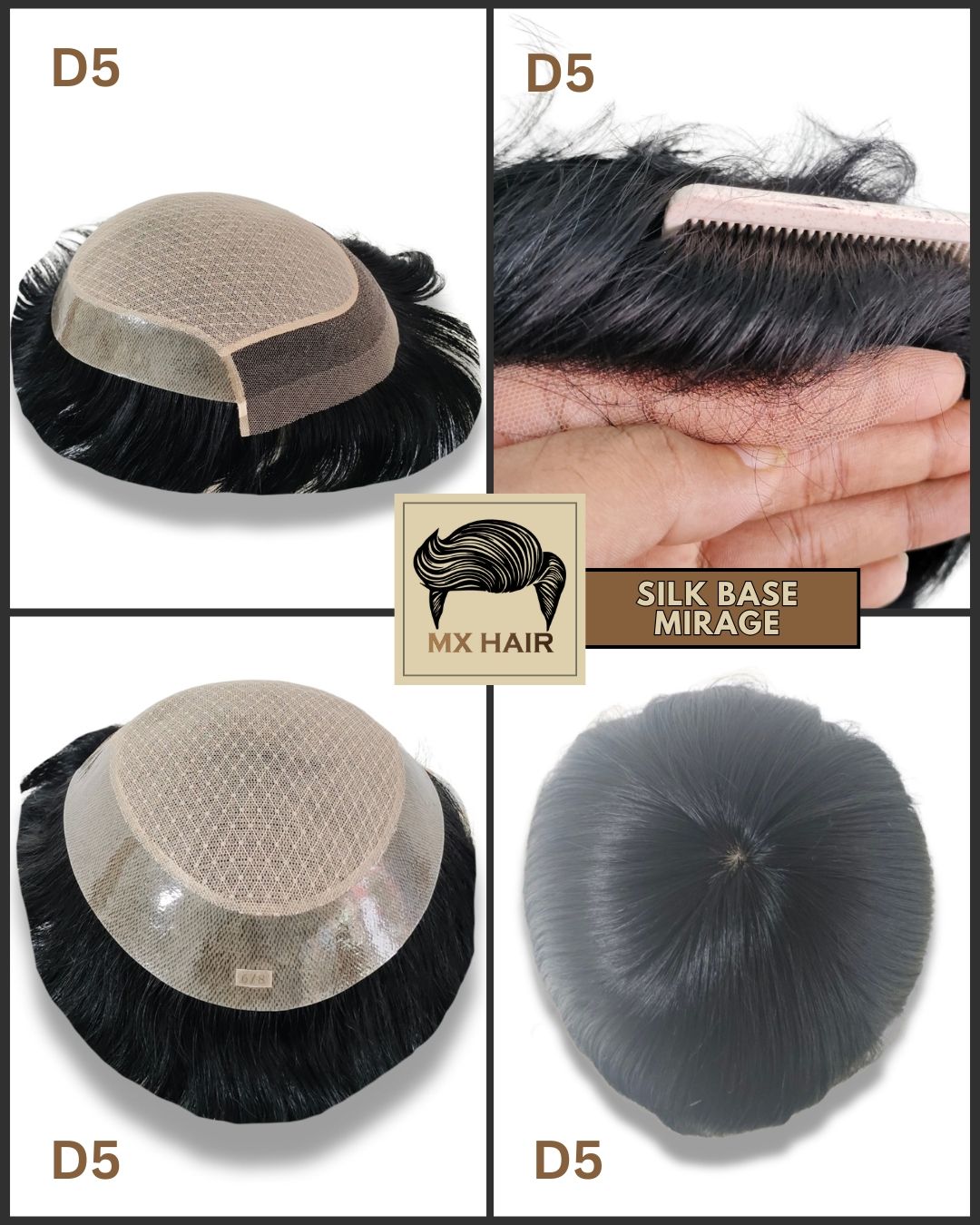
| Silk | Hidden knots, natural parting | 4–5 months |
MX Hair manufactures all five base types — see the full breakdown in our guide to types of men’s hair systems.
How hair is attached to the base
Hand-knotting ties individual strands to the base one at a time, which allows hair to move and part naturally in any direction — the technique used for the most realistic hairlines. Machine-wefting sews hair onto the base in rows, which is faster to produce and more budget-friendly, but slightly less flexible in how the hairline can be styled.
Hair system vs. wig vs. toupee — what’s the difference?
“Wig,” “toupee,” and “hair system” get used interchangeably, but a modern hair system is built with far more precision than either older term implies. A wig typically covers the entire head and isn’t shaped to a specific bald pattern; a toupee is the older term for a partial hairpiece, often less refined at the hairline. A hair system is custom-sized to the wearer’s exact area of hair loss, with density and color matched individually — which is what makes it disappear against real hair rather than sit on top of it.
From the factory floor
Every MX Hair system starts as raw human hair, sorted by texture and length before a single strand is knotted. It’s this hand-knotting stage — not the marketing copy — that determines whether a hairline looks real.
Why do men need a hair system?
Most men who wear a hair system are managing androgenetic alopecia (male pattern baldness), the most common cause of hair loss, though some are addressing alopecia areata, traction alopecia, or hair thinning from other causes. The American Academy of Dermatology’s overview of hair loss types is a good starting point if you want to understand the underlying cause before choosing a solution.
Who uses a men’s hair system?
Hair systems are worn by men experiencing pattern baldness or thinning who want an immediate, non-surgical result, as well as performers and public-facing professionals who want a reversible option without committing to permanent surgery. Salons and distributors also stock them as a standard offering for clients who aren’t candidates for, or don’t want, transplant surgery.
How much does a men’s hair system cost?
Retail pricing typically runs $40–$65 per unit depending on base type, hair quality, and density. Salons and distributors ordering factory-direct through a manufacturer see meaningfully lower per-unit costs at wholesale volume — see our 2026 wholesale price list for exact tiers, or browse current stock in the MX Hair shop.
Hair system vs. hair transplant
A hair transplant is a surgical, permanent procedure with a recovery period measured in months. A hair system is non-surgical, reversible, and delivers a full result the same day it’s fitted. For most first-time buyers, upfront cost and recovery time are the deciding factors between the two — we cover this comparison in full in Hair System vs. Hair Transplant: A Cost and Comfort Comparison.
How to choose your first hair system
- Start with a skin or mono base — generally the easiest for a first-time wearer to apply and maintain.
- Order a sample unit before committing to a bulk or long-term order.
- Match density and color as closely as possible to your natural hair.
- Confirm the base size against an accurate scalp measurement rather than a generic size chart.
For a deeper look at base selection, see Lace vs. Skin Base Hair System: Which Is Better for Your Salon?
FAQs
What is a men’s hair system made of?
Most men’s hair systems combine a base material (lace, skin, mono, net, or silk) with human or synthetic hair hand-knotted or wefted onto it to create a natural-looking hairline.
Is a hair system permanent?
No — hair systems are non-surgical and can be worn daily, removed, or replaced, unlike permanent solutions such as hair transplants.
Explore MX Hair’s base types
Lace, skin, mono, net, and silk base hair systems in stock, with factory-direct wholesale pricing for salons and distributors.
Message Us on WhatsApp Visit the Shop